
Starting a real estate photography business is about more than just knowing your way around a camera. It's about mastering your craft, getting the right gear, and setting up a professional business from day one. Your real mission is to build a standout portfolio and get your work in front of real estate agents, showing them how your images can help sell properties faster.
Why Real Estate Photography Is a Booming Business
So, is now still a good time to jump into real estate photography? Absolutely. Think about it: 97% of homebuyers start their search online. That first impression of a home is almost entirely visual, making professional photos an absolute necessity, not just a nice-to-have.
This is where you come in. You’re not just selling pictures; you're providing a crucial marketing tool that directly impacts an agent's success. Your work helps them grab a buyer's attention, book more showings, and close deals faster. That’s a service they will gladly pay for.
The Financial Impact of Professional Photos
The value of what you do isn't just a feeling—it's backed by some serious numbers. Listings with high-quality photos don't just look prettier; they perform better across the board. From getting more clicks to fetching higher sale prices, your camera becomes a revenue-generating tool for your clients.
Consider this: properties with professional photos get 47% more online views and up to 39% more inquiries. That alone can turn a stagnant listing into a quick sale. Even better, those same listings often close for $934 to $116,076 more than homes shot with an iPhone. You can dig into more of the data on how professional photos impact real estate sales.
Key Takeaway: You aren't just an expense for an agent; you're an investment with a clear and compelling return. Framing your services this way is how you win clients.
Your Role Is Evolving Beyond Still Images
The job title "real estate photographer" doesn't quite cover it anymore. While fantastic still photos are the foundation, the best agents are looking for a complete visual marketing package. This shift is a golden opportunity to add new, high-value services to your offerings.
Top photographers are now a one-stop-shop, providing:
- Drone Photography: Offering those stunning aerial shots that show off the entire property, its lot lines, and the neighborhood context.
- Video Walkthroughs: Creating smooth, cinematic tours that give buyers a real feel for the home's layout and flow.
- 3D Virtual Tours: Building immersive, self-guided experiences where potential buyers can explore every nook and cranny from their couch.
By adding these services, you transform from "the photo guy" into an essential marketing partner. It's the best way to command higher fees and build lasting relationships with the top-producing agents in your area.
To help you get started, here’s a look at what your first 90 days might look like. This timeline breaks down the journey from idea to your first paid shoot into manageable steps.
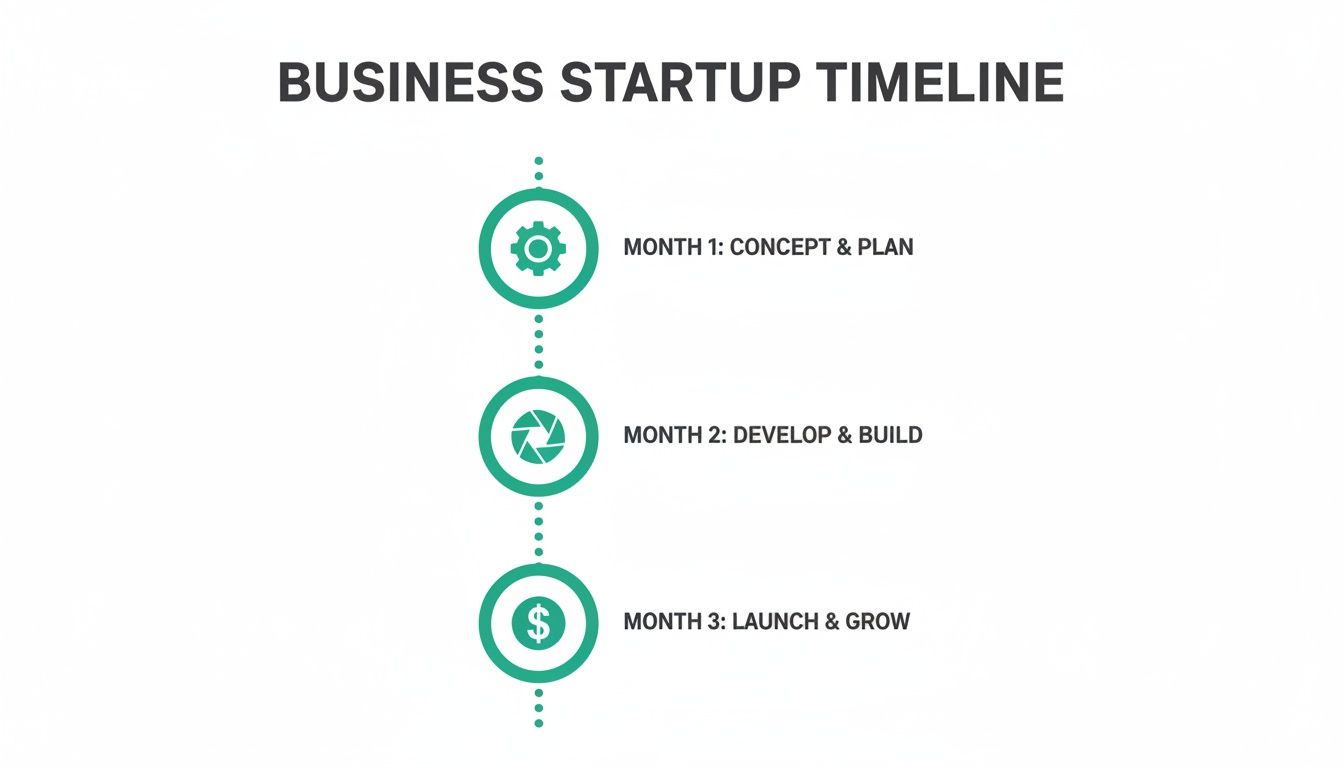
This quick-start plan is designed to help you build a solid foundation before you start actively looking for clients, ensuring you’re ready to deliver from day one.
Your First 90 Days Quick Start Checklist
To make this even more concrete, here is a checklist that breaks down the key milestones for your first three months.
| Milestone | Key Actions | Target Timeline |
|---|---|---|
| Establish Your Foundation | Define your niche, set up your legal business entity (LLC or Sole Prop), and open a business bank account. | Month 1 |
| Acquire & Master Your Tools | Purchase essential camera gear, lenses, and a tripod. Subscribe to and learn your editing software (Lightroom & Photoshop). | Month 1 |
| Build Your Portfolio | Shoot 3-5 properties for free (friends, family, or a new agent) to create a strong portfolio. | Month 2 |
| Define Your Brand & Pricing | Create your logo, set up a simple website, and develop your pricing packages and service menu. | Month 2 |
| Launch Your Marketing | Create social media profiles, print business cards, and start networking with local real estate agents. | Month 3 |
| Secure Your First Client | Reach out to your network, follow up with agents, and book your first paid real estate photography shoot. | Month 3 |
Following a structured plan like this prevents you from getting overwhelmed. Just focus on one milestone at a time, and you'll be running a professional operation before you know it.
Building Your Foundation: Gear, Software, and Legalities
To build a real estate photography business that agents actually trust, you need more than just a good eye. You've got to build a solid foundation with the right equipment, smart software, and a legit business setup. Skipping these early steps is like building a house on sand—it might look fine at first, but it won’t hold up when things get busy.
Let's get past the vague advice and dig into what you really need. This isn’t just a checklist; it's the strategic plan for looking professional and being profitable from day one.
Assembling Your Essential Photography Gear
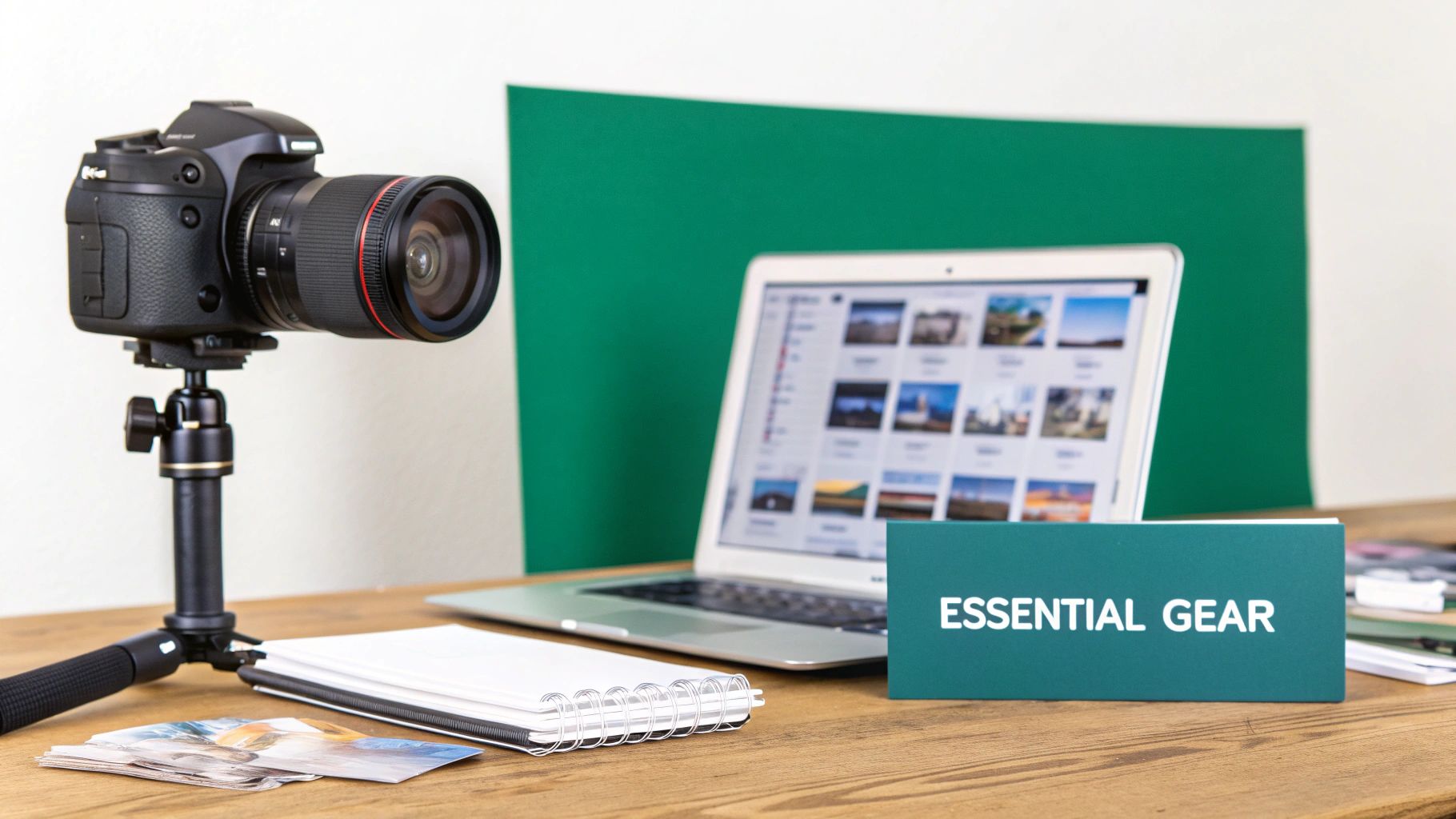
Your camera bag is the core of your service. While you don't need to drain your savings, you absolutely need tools that produce professional, consistent results. Agents are paying for quality they can't get from their iPhones, and your equipment is the first step in delivering on that promise.
Here are the non-negotiables you should have:
- A Capable Camera Body: You'll want a DSLR or mirrorless camera that gives you full manual control. A full-frame sensor is the gold standard here, especially for its performance in low-light situations, but a modern crop-sensor can also get the job done.
- A Wide-Angle Lens: This is your money-maker. A focal length in the 16-35mm range is the sweet spot for capturing an entire room without that weird, distorted "fish-eye" look.
- A Sturdy Tripod: Sharp, crisp images often require slower shutter speeds than you can manage by hand. A reliable tripod is your best friend for eliminating camera shake and guaranteeing every shot is tack-sharp.
Beyond those basics, you'll need some lighting. Natural light is great, but a good external flash or speedlight is critical for filling in dark corners and balancing the exposure between a bright window and a shadowy interior. If you want to get into the nitty-gritty of specific models, our comprehensive https://propphoto.com/blog/real-estate-photography-gear-guide breaks down options for every budget.
Pro Tip: Don't get hung up on having the most expensive gear right out of the gate. A solid, mid-range setup is more than enough to produce incredible images. Focus on mastering what you have before you start eyeing that next big upgrade.
Choosing the Right Software for Your Workflow
Taking the pictures is only half the job. Your post-production workflow is where you turn good photos into stunning marketing assets, and the right software makes this process fast and scalable. There's a reason two programs dominate the industry.
Adobe Lightroom is essentially your digital darkroom. This is where you’ll do the heavy lifting—importing and organizing shoots, culling images, and making batch edits. Its real power lies in creating presets to apply consistent adjustments (like color correction and lens corrections) to hundreds of photos at once. This will save you an unbelievable amount of time.
Adobe Photoshop is your tool for the detailed, surgical work. While Lightroom handles the broad strokes, Photoshop is for the fine-tuning. Think removing a distracting power cord, swapping a gray, overcast sky for a perfect blue one, or blending multiple exposures for a jaw-dropping twilight shot.
A dialed-in software workflow is what allows you to promise—and deliver—a full gallery within 24-48 hours, which is a huge selling point in the fast-paced world of real estate.
Setting Up Your Business, The Right Way
Okay, this is the part a lot of creatives want to skip, but it’s what separates a side hustle from a real, professional business. Getting your legal and financial house in order isn't just about following the rules; it's about protecting yourself and building credibility from the start.
Here are the critical moves to make:
- Pick a Business Structure: For most people starting out, the choice is between a Sole Proprietorship or a Limited Liability Company (LLC). A sole prop is the simplest—you and the business are the same legal entity. An LLC costs a bit more to set up, but it provides a crucial layer of liability protection by separating your personal assets (like your house and car) from your business debts.
- Open a Business Bank Account: This is non-negotiable. Never, ever mix your personal and business finances. A dedicated business account makes tracking income and expenses a breeze, which is a lifesaver come tax time and helps you see how profitable you really are.
- Get Business Insurance: At a minimum, you need general liability insurance. It protects you if something goes wrong on a shoot—say, your tripod gets knocked over and shatters an expensive vase. This coverage gives both you and your clients serious peace of mind.
Taking these steps shows agents you’re not just a person with a camera, but a serious professional running a reliable operation. This foundation of proper gear, efficient software, and a legitimate legal structure is your launchpad for building a business that lasts.
Pricing and Packaging Your Services for Profit
Let's talk about the one thing that trips up almost every new real estate photographer: pricing. It can feel like a tightrope walk. Price too low, and you're not just leaving money on the table—you're signaling that your work isn't valuable. Price too high, and you might scare away the very agents you need to build momentum.
The secret isn't just to pick a number. It's to build a smart pricing strategy that communicates your value and ensures you’re profitable from your very first shoot. Ditch the idea of just sending agents a simple price list. The real pros guide their clients toward higher-value options by creating well-thought-out service packages. This makes the agent's decision easier and, more importantly, bumps up what you earn on every single job.
Calculating Your Base Rate
Before you can even think about packages, you have to know your numbers. Seriously. Your pricing has to cover your costs, your time, and—this is the important part—your profit. A rookie mistake is to only factor in the hour or two you spend on-site. That's just the tip of the iceberg.
Your price for a single shoot needs to account for everything:
- Time on-site: The actual time you spend at the property.
- Editing and processing: This is the hidden time-suck. For every hour you shoot, you can easily spend two more culling, editing, and delivering the final images.
- Gear amortization: Every click puts wear and tear on your camera, lenses, and computer. A small fraction of that cost needs to be baked into each job.
- Software and subscriptions: Your monthly fees for Adobe Lightroom, your gallery delivery system, and any other tools are real business expenses.
- Business overhead: Don't forget insurance, marketing, gas for your car, and business licenses.
- Your profit: This is what’s left over for you after every single expense is paid.
Once you have a handle on what it actually costs you to do a job, you can set a baseline price that guarantees you're making money. Don't just look at what your competitor is charging and copy it; their financial situation is completely different from yours.
Structuring Your Service Packages
With your base rate nailed down, you can start building out your packages. The idea here is to create a "good, better, best" scenario. Your goal is to make that middle-tier package so compelling that it becomes the obvious choice for most agents—the perfect mix of value and price.
Here’s a quick look at how you might structure three packages that build on each other.
Example Service Packages and Pricing Tiers
This table shows a classic three-tier structure that works incredibly well for guiding agents to the best-value option.
| Package Tier | Included Services | Example Price Range |
|---|---|---|
| Essential Photos | • 25 High-Resolution HDR Photos • Interior & Exterior Shots • 24-Hour Turnaround |
$175 - $250 |
| Pro Marketing Kit | • All services from Essential Photos • 5-10 Aerial Drone Photos • Social Media Teaser Video (15-sec) |
$350 - $475 |
| Ultimate Listing | • All services from Pro Marketing Kit • Cinematic Video Walkthrough (2-3 min) • Twilight Exterior Photos (4-6 images) |
$600 - $850 |
See how that works? The structure isn't just a list of services; it's a sales tool. The "Pro Marketing Kit" is almost always the bestseller because it adds drone photos—a massive selling point—for a reasonable jump in price.
For a deeper dive into different pricing models, check out our complete guide on how to price real estate photography.
Key Insight: Notice how each package builds upon the last. This technique, known as value-stacking, makes it easy for a client to see the benefit of upgrading to the next tier.
Pricing Models: Flat Rate vs. Per Photo
So, how do you actually bill for these packages? The two most common methods in this industry have their own quirks.
A per-photo pricing model (like charging $10 per image) seems straightforward, but it can lead to headaches. You'll find yourself in pointless debates with agents about whether a shot of the pantry is "necessary" just so they can save a few bucks. It also puts a ceiling on how much you can earn from smaller homes.
On the other hand, a flat-rate package model (like the one in the table) is clean, professional, and transparent. The agent knows exactly what they’re getting and exactly what it will cost. This builds trust and positions you as a partner, not just a vendor. For anyone serious about starting a real estate photography business, flat-rate packages are almost always the way to go for better profits and a smoother client experience.
The demand for high-quality visuals is only growing. The global real estate photography market is expected to climb from $2.4 billion in 2024 to $4.5 billion by 2035. In busy markets, photographers who bundle a standard photo shoot ($200-$500) with popular add-ons like drone (+$100-$300) and 3D tours (+$200) are setting themselves up to earn anywhere from $50K to $150K annually. You can find more data on photographer earnings at PhotoUp.net. This trend confirms that agents are ready to invest in a full marketing package, making your strategic bundling more crucial than ever.
How to Market Your Business and Land Your First Clients

You can have the best camera gear and the most perfectly crafted packages, but none of that matters if your calendar is empty. This is where the real work begins—turning your photography skills into actual, paying gigs.
Your first mission, before anything else, is to build a portfolio that stops real estate agents in their tracks. It needs to instantly answer their biggest question: "Can this person make my listings look incredible?" Without a solid portfolio, you're just asking them to take a blind risk on you.
Building Your Portfolio from Scratch
If you're starting from square one with zero real estate photos, you need to get some, and fast. This is one of the very few times it actually makes sense to work for free. Don't think of it as giving away your time; see it as investing in your single most critical marketing asset.
Here's a simple game plan to get it done:
- Tap Your Network: Know any friends or family members who are especially proud of their home? Offer them a free photoshoot. All you need in return is their permission to use the images for your portfolio.
- Partner with a New Agent: Find a real estate agent who is also just getting started. They desperately need high-quality photos for their listings but might not have a big budget. Propose a free shoot for their first listing. It’s a classic win-win that could easily blossom into a long-term partnership.
The immediate goal is to get three to five diverse properties in your portfolio. Aim for a mix of interiors, exteriors, and a few unique detail shots. This collection of images is your ticket into the game.
Key Takeaway: Your portfolio must prove you can solve an agent's problem. Every photo should scream "professional," "bright," and "inviting." Focus on developing a clean, consistent editing style right from the start.
Direct Outreach That Actually Works
With a solid portfolio in hand, it's time to go on the offensive. Sitting around and waiting for agents to discover you is a painfully slow strategy. You have to proactively connect with the people who hire photographers every single week.
The most effective method is targeted, personal outreach. Forget about blasting out generic mass emails. Your mission is to identify the heavy hitters in your local market and show them exactly how you can help them sell homes faster and for more money.
For a complete blueprint on finding and winning over clients, you’ll want to check out our deep-dive guide on how to get real estate photography clients.
Start by researching the top-producing agents and teams in your area. Take a look at their current listings. Do their photos look a bit dated, dark, or amateurish? That’s your opening.
Craft a personalized email that follows this simple formula:
- A Genuine Compliment: "Hi [Agent Name], I was really impressed with your recent sale on Elm Street. The way you marketed that property was fantastic."
- A Clear Value Proposition: "I specialize in creating the kind of bright, vibrant real estate photos that help top agents like you attract more buyers. I noticed you have a new listing coming up, and I think my style could really make it pop online."
- A Low-Risk Offer: "Would you be open to me shooting one of your upcoming listings at a special introductory rate? I’m confident you’ll be thrilled with the results."
- A Simple Call to Action: "You can see a few examples of my work right here: [Link to your portfolio website]."
This approach immediately shows you've done your homework and are focused on their success, not just on making a quick buck.
Creating Your Online Presence
In this business, your online presence is your digital storefront. It doesn’t have to be complicated, but it absolutely must look professional. Agents are busy people; they want to see your work and find your contact info in seconds.
At the bare minimum, you need these two things:
- A Simple Portfolio Website: This is your home base. Use a platform like Squarespace, Wix, or Format to build a clean, image-first site. All you really need are a few pages: a gallery of your best work, a clear "Services & Pricing" page, and an easy-to-find "Contact" page.
- An Instagram Profile: Real estate is a visual game, which makes Instagram the perfect social platform to showcase what you do. Post your best photos, tag the agents and stagers you work with, and use local hashtags agents are actually searching for (like #AustinRealEstate or #MiamiHomes).
Think of your website as your professional resume and your Instagram account as your daily highlight reel. They work together to build trust and make it incredibly easy for agents to find you, like your work, and hire you for their next big listing.
Ready to Scale? Moving Beyond a One-Person Show

Once you've got a steady flow of clients, the entire game changes. You’re no longer just trying to survive; you're building for sustainable growth. The goal shifts from simply shooting more houses to increasing the value of every single job, all without burning out. This is where you level up from being a photographer to a full-blown visual marketing partner by adding high-margin services and creating workflows that are absolutely bulletproof.
Scaling your business is all about working smarter, not harder. It’s what separates a freelancer who’s constantly chasing the next gig from an owner running a thriving, scalable business.
Add Services That Agents Will Pay a Premium For
The fastest way to boost your revenue is to start offering services that most other photographers don't. Top real estate agents are always looking for an edge, and they will gladly pay a premium for a complete marketing package from one person they already trust.
When you add these services, you're not just increasing your average order value; you're making yourself indispensable to your best clients. The data shows this is where the industry is heading. In fact, by 2025, it’s predicted that 82% of agencies will use drones, especially since listings with aerials see a 68% sales boost. And while virtual tours are becoming more common, only about 15% of firms are using advanced digital twins like Matterport. This creates a huge opportunity for photographers who get in on the technology early. You can dig into more photographic services market trends in the full report from Precedence Research.
Here are the key services you should seriously consider adding:
- Drone Aerials: This is usually the easiest and most profitable first step. Aerial shots give a property context, show off its size and unique features, and instantly give a listing a high-end feel.
- 3D Virtual Tours: Tools like Matterport create immersive, self-guided tours that let potential buyers explore a home from anywhere in the world. This is a massive value-add for agents dealing with out-of-town clients.
- Cinematic Video Walkthroughs: A well-produced video tells a story that still photos just can't. It captures the flow of the home and can create a powerful emotional connection with buyers before they even step inside.
Pro Tip: Don't even think about buying new gear until you have the right certifications. For any commercial drone work in the U.S., you absolutely must get your FAA Part 107 license. Flying without it puts you and your clients at serious legal and financial risk.
Create Workflows That Can Handle the Volume
As you get busier, your old ways of doing things will start to crack under the pressure. Trying to juggle scheduling through a mix of emails, texts, and phone calls is a recipe for disaster. To handle more clients without losing your mind, you need to build systems that automate the repetitive, time-sucking parts of your job.
A solid workflow is your secret weapon for delivering consistency and efficiency. It guarantees every client gets the same professional experience and every property is shot to the same high standard, no matter how packed your schedule is. This is a non-negotiable step when you're learning how to start a real estate photography business that's built to last.
Focus on automating these key areas:
- Online Booking: Get a scheduling tool like Acuity or Calendly. You can set your availability, create different appointment types for your packages, and let agents book and pay for shoots online, 24/7. No more back-and-forth emails.
- Consistent Shot Lists: Create a standardized shot list template that you use for every single shoot. This ensures you never miss a critical angle and helps you move through a property efficiently and methodically every time.
- Professional Delivery: It's time to ditch the Dropbox and Google Drive links. A professional gallery delivery system like Aryeo or PhotoUp provides a branded, impressive client experience. These platforms let you deliver everything—photos, videos, 3D tours—in one polished package and often include handy features like download tracking or even marketing tools for your agents.
Answering Your Biggest Questions About Starting Out
Jumping into any new business venture is bound to stir up a ton of questions. It's totally normal. You're probably wondering about everything from how much you can actually make to whether your current skills are good enough.
Let's clear the air and tackle some of the most common things that hold new real estate photographers back.
How Much Can I Realistically Earn?
This is the big one, right? The good news is, the answer is pretty straightforward: what you earn comes down to your local market, what you’re selling, and how many jobs you can land.
Someone starting out part-time in a smaller town could reasonably add an extra $1,000 to $2,000 to their monthly income once they get going. It's a great side hustle.
But if you go full-time in a busier city and offer the whole package—photos, drone, and video—you could be looking at $50,000 to $75,000 within your first couple of years. The photographers who really crush it, the ones who become the go-to for top-producing agents, can absolutely clear $100,000 a year. It all depends on how you price yourself and the value you bring to the table.
My Take: Don't expect to get rich overnight. Your first year is about building a solid client list and reputation. As you add high-demand services like drone shots and 3D tours, your income potential will climb fast. Focus on quality, and the money follows.
Do I Need to Be an Expert Photographer to Start?
Let me be clear: absolutely not. You don’t need a fine arts degree or a background in wedding photography. Real estate photography isn't about capturing fleeting artistic moments; it’s a technical skill, a craft that you can learn and perfect.
Instead of trying to be a master of all photography, just get really, really good at a few key things specific to this niche.
- Bracketing for HDR: This is non-negotiable. You have to learn how to shoot multiple exposures (dark, normal, bright) and blend them together. It's the only way to get a perfectly exposed photo where you can see both the details inside a room and the view outside a bright window.
- Composing for Tight Spaces: Your job is to make rooms look spacious and welcoming, not cramped and weird. That means learning to shoot from corners, keeping your vertical lines perfectly straight, and knowing how to use a wide-angle lens without making everything look distorted.
Nail these two fundamentals, and your work will instantly stand out from the crowd.
What's the Biggest Mistake New Photographers Make?
It’s not a technical mistake, like using the wrong camera setting. The most common and damaging mistake I see is a one-two punch of bad business decisions: pricing your services way too low and working without a contract.
When you underprice, you attract the wrong kind of clients—the bargain hunters who don't value quality. It screams that you aren't confident in your work, and it leaves you with no money to invest in better gear or marketing. You just end up burned out and broke.
Flying without a contract is just as dangerous. It opens you up to all sorts of problems over payment terms, how the images can be used, and what you were even hired to do. A simple, clear agreement protects both you and the agent, setting expectations from the start so there are no surprises later. Value your work, and protect your business.
Ready to stop chasing clients and have them find you instead? Join the PropPhoto marketplace to create your free professional profile, showcase your portfolio, and get booked directly by top real estate agents in your area. Start building your business on PropPhoto.
Article created using Outrank

