
Let's be honest, when you're lining up the perfect shot for a high-end property, the last thing you're thinking about is what could go wrong. But what happens when a client stumbles over your light stand? Or your drone has a very expensive meet-and-greet with a stubborn oak tree?
That’s where business insurance for photographers comes in. Think of it less as an annoying expense and more as your professional safety net, the one thing that protects your gear, your reputation, and your bank account when things go sideways. It’s a core asset for building a serious, trustworthy brand.
Why Smart Photographers Prioritize Business Insurance
It’s easy to look at business insurance as just another bill to pay, but that’s a dangerously common mindset for creative entrepreneurs. A better way to frame it is as a powerful tool that opens doors, builds trust with clients, and lets you sleep at night. Without it, one simple accident could put not just a single project in jeopardy, but your entire business.
This guide is all about shifting that perspective—from seeing insurance as a nagging cost to understanding it as your most valuable business asset. It’s not just about dodging disaster; it’s about laying a solid foundation for success. For photographers shooting for real estate agents, brokerages, or listing on platforms like PropPhoto, proof of insurance is often a non-negotiable requirement. It’s a clear signal that you’re a professional they can rely on, which is exactly how you land the bigger, better-paying clients.
Shielding Your Business From Common Risks
Every single time you step onto a property, you're taking on some level of risk. They can range from tiny mishaps to career-altering liabilities, and a good insurance policy is built to handle the specific curveballs a photographer might face.
Let's look at the hard truth for small businesses. A shocking number of them get hit with legal action or claims every single year, often from accidents that seem completely mundane. In fact, statistics show that between 36% and 53% of U.S. small businesses are sued annually. At least 43% face claims tied to things like a simple on-site slip-and-fall or accidental property damage. For a photographer, that could easily be a homeowner tripping over a camera bag or a C-stand leaving a deep scratch in a brand-new hardwood floor. You can read more about the risks photographers face and how to mitigate them.
When you buy an insurance policy, you’re essentially transferring these huge financial risks from your own pocket to an insurance company. It’s a strategic move that lets you work with confidence, knowing you have a financial backstop if the unexpected happens.
The True Value of Protection
At the end of the day, business insurance for photographers does a lot more than what’s written on the policy document. It’s a multi-purpose tool that actively supports your business and your goals.
- Financial Security: It covers the kind of costs that can sink a small business, like legal defense fees, medical bills, and replacing thousands of dollars in gear.
- Client Confidence: A Certificate of Insurance (COI) is your golden ticket. Commercial clients, big brokerages, and property managers often won't even talk to you without one.
- Business Continuity: If your main camera gets stolen or your go-to lens is destroyed, insurance helps you repair or replace it fast so you can get back to shooting without missing a beat.
- Reputation Management: It defends you against claims of professional negligence (like if you delivered the wrong photos), protecting the valuable brand you've worked so hard to build.
Understanding Your Core Coverage Options
Diving into business insurance can feel like learning a new language, filled with strange terms and a dizzying number of policies. But for a professional photographer, it's the single most important step you can take to build a business that lasts. Think of it as assembling a custom-fit suit of armor, with each piece designed to protect you from the specific risks you face on every single shoot.
Each type of insurance policy is like a specialized shield. Some guard your expensive gear, others protect your professional reputation, and the most basic ones cover you for the simple accidents that can happen when you're working on-site. Let's walk through the essential coverages you need to know, starting with the absolute must-haves.
General Liability: Your On-Location Shield
General Liability is the foundation of any photographer's insurance plan. This is your first line of defense against claims of third-party bodily injury or third-party property damage.
Picture this: you're setting up for a twilight shoot, and the homeowner trips over your tripod leg, breaking their wrist. Your General Liability policy is what steps in to cover their medical bills and any legal fallout. Or maybe you're adjusting a light stand and accidentally knock over a pricey vase. This policy pays to repair or replace it. It's all about covering the physical, real-world mishaps that can happen when you and your gear are in someone else's space.
This coverage isn't just a "nice-to-have." Most commercial clients, real estate brokerages, and property managers will refuse to work with you unless you can show proof of at least $1 million in General Liability coverage. It’s a non-negotiable for playing in the professional leagues.
The image below gives you a great visual of how these different insurance shields come together to protect the core pillars of your photography business—your gear, your reputation, and your client relationships.
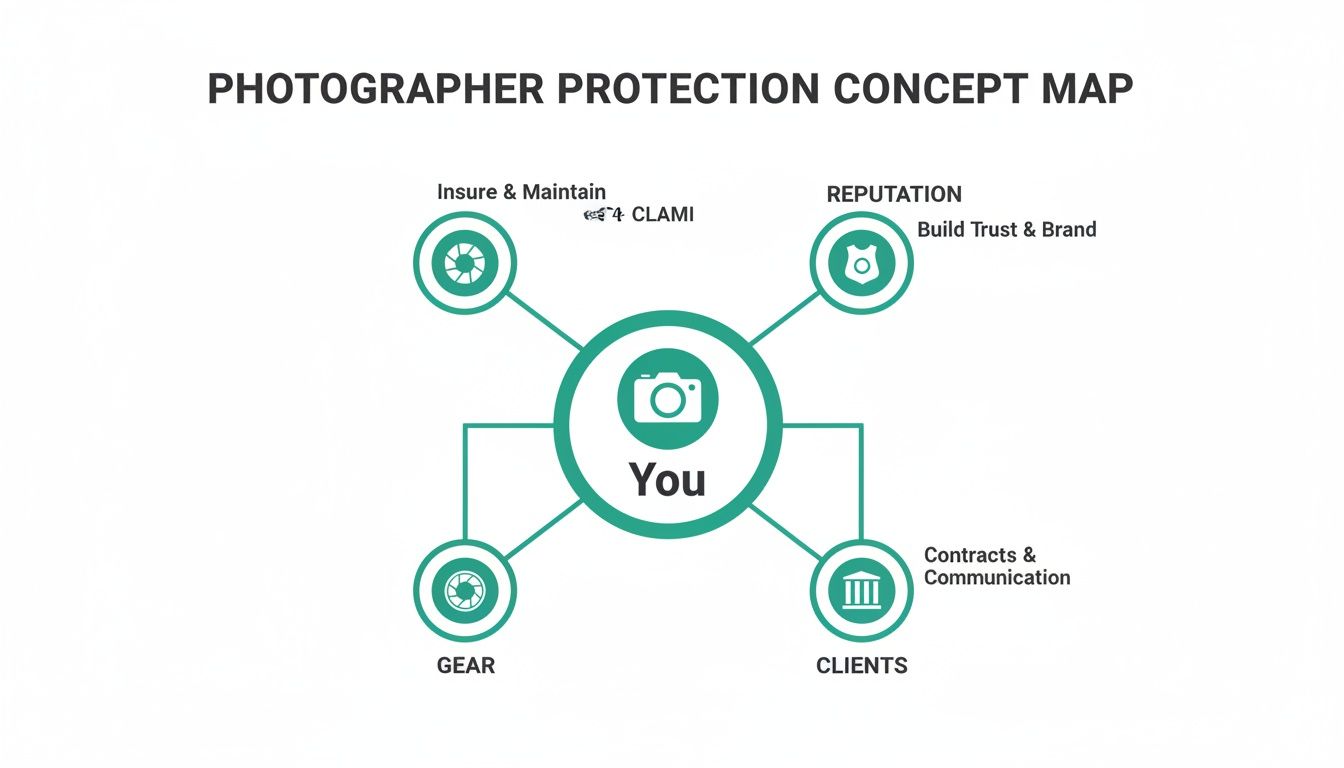
As you can see, a smart insurance strategy is about more than just protecting your camera; it's about safeguarding every part of your professional life.
Professional Liability: Your Creative Safety Net
While General Liability covers physical accidents, Professional Liability—often called Errors & Omissions (E&O) insurance—is all about protecting you from claims tied to the service you provide. This is your safety net for creative or technical screw-ups.
What happens if your memory card corrupts and you lose every single photo from a critical new listing? The agent could sue you for the financial damage they suffered from the marketing delay. Professional Liability is designed to cover your legal defense and any potential settlements in situations like these, which can include:
- Accidental file deletion or a hard drive crash.
- Delivering the wrong gallery to a client.
- Missing a crucial shot that was specifically requested in your contract.
- Allegations of negligence if a client feels your work didn't meet professional standards.
This coverage defends your reputation and your bank account when a simple mistake in your workflow causes a client to lose money.
Equipment Insurance: Your Gear’s Bodyguard
Let's be honest: your cameras, lenses, drones, and lights are the lifeblood of your business. Equipment Insurance, which you'll often see referred to as Inland Marine insurance, is built specifically to protect these valuable tools from theft, damage, or loss. It covers your gear whether it's at your home office, in your car, or on location.
This is a huge deal, because your standard homeowners or renters policy almost always excludes property used for business. If someone smashes your car window and grabs your camera bag while you're grabbing lunch between shoots, your personal policy won't touch it. Equipment insurance will. It ensures you can get your gear repaired or replaced fast, minimizing your downtime without having to drain your savings.
To make this even clearer, here's a quick cheat sheet summarizing the essential policies and what they do.
A Quick Guide to Photographer Insurance Policies
This table breaks down the main types of insurance, what they cover in simple terms, and a real-world scenario where you'd be glad you have it.
| Insurance Type | What It Covers | Example Scenario |
|---|---|---|
| General Liability | Bodily injury to others or damage to their property caused by you or your equipment. | A client trips over your light stand and breaks their arm, requiring hospital care. |
| Professional Liability (E&O) | Financial losses a client suffers due to a mistake or negligence in your professional services. | You accidentally format the wrong memory card, losing all photos from a high-end listing shoot. |
| Equipment/Inland Marine | Theft, damage, or loss of your professional gear, whether on-site, in transit, or at home. | Your camera bag containing thousands of dollars worth of lenses is stolen from your locked car. |
| Commercial Auto | Liability and physical damage coverage for accidents that occur while using your vehicle for work. | You get into a fender bender while driving to meet a real estate agent at a property. |
| Workers' Compensation | Medical expenses and lost wages for employees who are injured on the job. | An assistant you hired for a large commercial shoot slips on a wet floor and sprains their ankle. |
| Cyber Liability | Costs related to a data breach, such as notifying clients, credit monitoring, and legal fees. | Your online gallery hosting service gets hacked, exposing your clients' names and email addresses. |
Think of these policies as building blocks. You start with the foundation (General Liability) and add the other pieces as your business grows and your risks change.
Other Essential Coverages to Consider
As your business gets more complex, so do your risks. Beyond the big three, a few other policies might be necessary to plug any remaining gaps in your armor.
The photography insurance market is a big business for a reason. The global market for this coverage hit a value of $1.8 billion, with North America making up 38% of that. This isn't surprising, given how many professional photographers are out there shooting HDR property images and flying drones, all of which come with risk. You can see more data on the photography insurance market and its growth trends.
Here are a few other policies to keep on your radar:
Commercial Auto Insurance: If you use your personal vehicle for work—driving to shoots, hauling gear—your personal auto policy probably won't cover you if you get in an accident while on the clock. You need a dedicated commercial auto policy to be properly protected.
Workers' Compensation: The minute you hire your first employee, whether it’s a part-time editor or a second shooter for a big job, most states legally require you to carry workers' comp. It covers their medical bills and lost wages if they get hurt working for you.
Cyber Liability Insurance: We live in an age of digital delivery. You're handling client names, addresses, and maybe even payment information through your online galleries and booking systems. Cyber Liability insurance is there to protect you from the crushing costs of a data breach, which can include everything from notifying clients to paying for credit monitoring services.
Calculating Your Coverage Needs and Costs
Trying to land on the right amount of insurance can feel like a shot in the dark, but it’s one of the most important decisions you'll make for your photography business. Go too low, and you're one bad accident away from a financial nightmare. Insure for too much, and you're just throwing away money that could be reinvested into growing your business. The sweet spot is finding that perfect balance where you’re fully protected without overpaying.
To do this, you need to get a clear-eyed view of two things: your liability exposure and the real-world value of all your gear. By breaking these down, you can stop guessing and start choosing coverage limits that actually match the work you do. This is how you move from just knowing what insurance is to understanding how much you truly need, giving you real control over your business's financial health.
Determining Your Liability Limits
For General Liability insurance, thankfully, the industry has a pretty clear standard. Most commercial clients you’ll work with—think real estate brokerages, property managers, and architects—will flat-out require you to carry a minimum of $1 million per occurrence and a $2 million aggregate limit.
So, what does that actually mean? Let’s break it down simply:
- Per Occurrence Limit: This is the most your insurance will pay for any single incident. If a realtor trips over your light stand and ends up with $50,000 in medical bills, your $1 million limit has you covered, no sweat.
- Aggregate Limit: This is the absolute total your insurer will pay out for all claims combined during your policy year.
That $1M/$2M standard isn't just some random number. It's based on the real potential costs of a serious lawsuit, which can easily include six-figure legal defense fees, medical bills, and settlement payouts. Meeting this requirement is non-negotiable for landing professional gigs; it’s the first thing clients look for to see if you’re a serious, professional operator.
Accurately Valuing Your Equipment
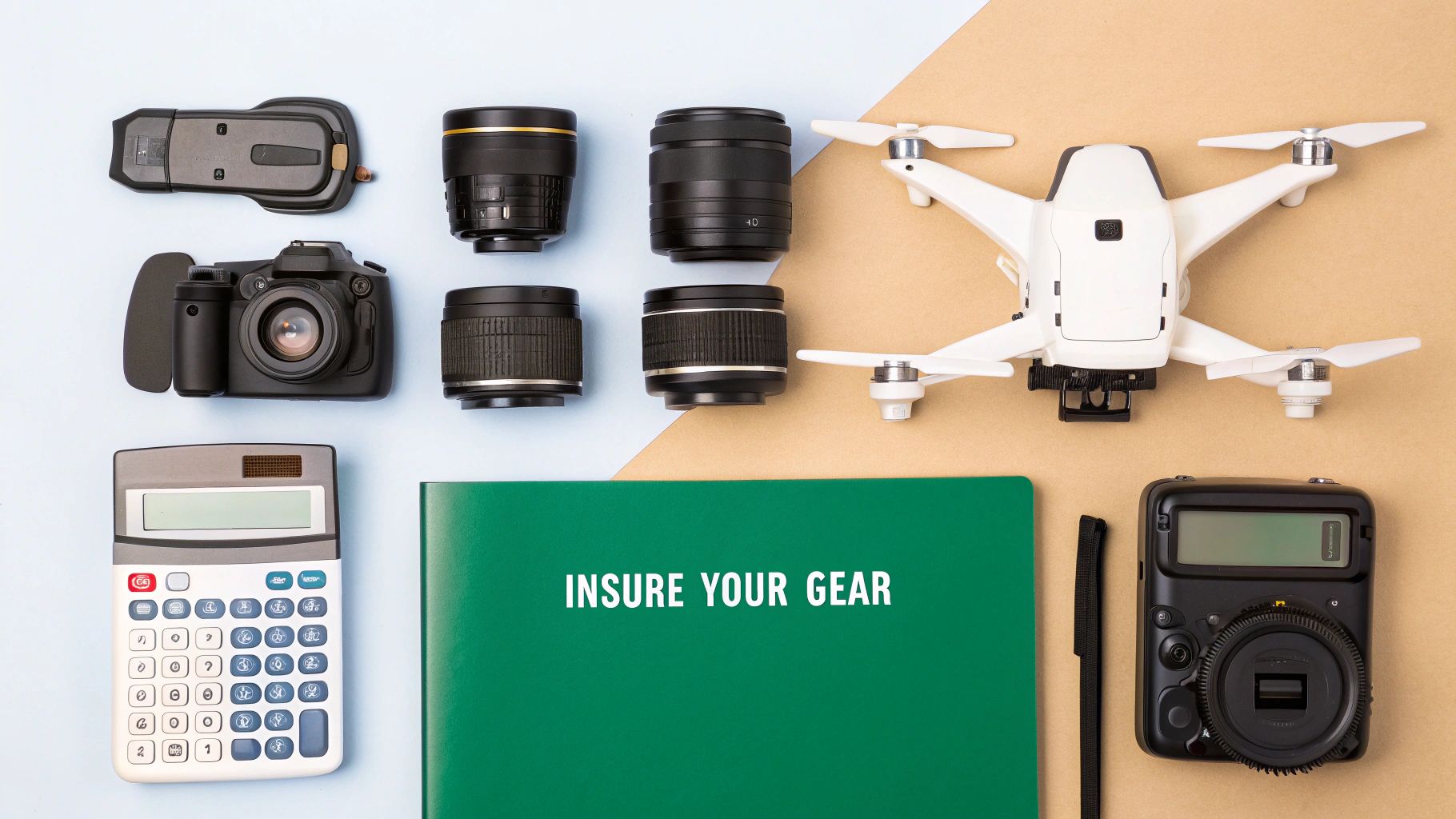
Next up is your gear. When it comes to your Equipment Insurance policy, this is where a lot of photographers make a huge mistake: they guess. Don't just pull a number out of thin air. You need to create a detailed inventory.
Seriously, open up a spreadsheet and list every single piece of gear you use for your business. I mean everything—from your main camera body all the way down to that expensive filter you bought last month.
Your Gear Inventory Should Absolutely Include:
- Cameras: Every body, including your backups.
- Lenses: All your prime, zoom, and specialty glass.
- Lighting: Strobes, speedlights, light stands, and every last modifier.
- Drones: The drone itself, controllers, and those pricey extra batteries.
- Support Gear: Tripods, gimbals, sliders—anything that holds your camera steady.
- Computers & Hard Drives: Your editing laptop and the external drives where your work lives.
- Accessories: Filters, memory cards, and even your camera bags.
Once you have your list, assign a replacement cost value to each item. This is crucial. You want to insure your gear for what it would cost to buy it brand new today, not what you paid for it two years ago. Add up that column, and that's the precise coverage amount you need for your equipment policy. It’s the only way to be sure you can get right back to work after a total loss.
Estimating Your Insurance Costs
Okay, so you have your coverage limits figured out. Now you can start to budget for the premiums. The good news is that solid business insurance for a photographer is often way more affordable than people assume. Your final price tag will depend on things like your location, your claims history, and the exact coverages you select.
But we can get a pretty good idea by looking at industry averages. For a solo photographer, general liability insurance often averages around $27 per month ($322 per year). In a place like California, you might see that number closer to $425 annually, which is still right in line with the national median.
And when you add gear coverage? It’s still surprisingly manageable. Some providers report median costs as low as $6 per month to protect $1,000 worth of equipment, or $15 per month for a $2,500 limit.
The smart move is to factor these costs directly into your business budget. If you know your insurance runs you about $50 a month, you can build that right into your pricing structure. That way, it becomes a predictable business expense, not a surprise bill that eats into your profits. If you need some help with that, check out our guide on how to price real estate photography for some practical tips.
How to Get Insured The Right Way
Okay, so you know what insurance you need. Now, how do you actually get it? This part can feel like a maze, but figuring out where to buy your policy is a huge part of setting up your business for success.
Your choice here isn't just about finding a policy; it's about deciding how much guidance, speed, and cost-effectiveness you want. There are basically three paths you can take, and each one is built for a different type of business owner. Let's dig in.
H3: Comparing Your Options for Buying Insurance
Think about it like buying a new camera. You could walk into a big-box electronics store, head to a dedicated camera shop, or just order one directly from the brand online. Each experience is totally different, and the same goes for insurance.
A traditional insurance agent is like a generalist—they handle home, auto, and business insurance, but might not know the nitty-gritty of what a real estate photographer actually does. A specialty broker, on the other hand, is the expert at the camera shop. They live and breathe this stuff and understand the unique risks you face. Then there are the online providers, which are fast, direct, and let you get covered in minutes.
Here’s a look at how these three options really stack up for a working photographer.
Comparing Ways to Buy Photographer Insurance
Weighing the pros and cons of different channels for purchasing your business insurance.
| Method | Pros | Cons | Best For |
|---|---|---|---|
| Traditional Agent | Often lets you bundle your business policy with home and auto for a discount. | May not fully grasp creative industry risks (like drone liability or E&O for photographers). | Photographers who already have a great relationship with an agent they trust for their other insurance needs. |
| Specialty Broker | They have deep expertise in the specific risks photographers face every day. | Can sometimes work with a smaller, more curated list of insurance companies. | Professionals who want tailored advice, especially for niches like architectural or aerial photography. |
| Online Provider | Super fast and convenient. You can literally get a quote and a policy in minutes. | You're mostly on your own. There’s less personalized guidance for choosing coverage. | Photographers who know exactly what they need and just want to get insured quickly and affordably. |
For a lot of photographers just starting out, online providers are a fantastic starting point. They hit that sweet spot of speed and affordability. If you're looking for more tips on getting your business off the ground, our guide on how to start a real estate photography business is a great place to continue.
Mastering the Certificate of Insurance
Once your policy is active, it's only a matter of time before a client asks for your Certificate of Insurance, or COI. Don't let the official name intimidate you; a COI is just a one-page document proving you're insured. It lists your coverage types, your policy limits, and the dates your policy is active.
A COI is your professional passport. It's the key that unlocks jobs with bigger clients like commercial property managers and real estate brokerages. They won't let you on-site without it, so having one ready shows you’re a serious professional.
Getting one is almost always a breeze. Most online insurers have a dashboard where you can generate a COI yourself anytime you need it, 24/7. If you're working with a traditional agent, a quick email or phone call is all it takes, and they'll usually have it sent over within a business day.
Handling "Additional Insured" Requests
Sometimes, a client won’t just ask for a COI—they'll also ask to be listed as an "additional insured." This is a very common and normal request, especially from larger real estate agencies.
All it means is that your client wants to be covered by your General Liability policy for any incidents related to the work you're doing for them. So, if a potential buyer trips over your light stand during a shoot and decides to sue both you and the real estate agency, your insurance policy would step in to defend them, too. It doesn't give them any control over your policy; it just extends your protection to them for that specific job.
Most insurance companies will add an additional insured for free or for a very small fee. When a client asks, you can respond with confidence:
"Absolutely, I can get that sorted for you. Could you please send me the exact legal name and address you need listed? I'll have my insurance provider issue an updated COI with you added as an additional insured right away."
A simple, professional response like this takes a potentially confusing request and turns it into another chance to show your client that you’re reliable and easy to work with.
Actionable Strategies to Lower Your Premiums
Getting the right insurance for your photography business is non-negotiable, but it doesn't have to break the bank. With a few smart moves, you can knock down your annual premiums without giving up the coverage you actually need. It all comes down to showing insurers that you're a safe bet, which always translates into savings.
The easiest win is often to bundle your policies. You've probably done this with your personal car and home insurance, and the same logic applies here. When you get your General Liability and Equipment Insurance from the same provider, they'll usually give you a multi-policy discount that can make a real difference.
Make Smart Policy Adjustments
Another lever you can pull is your deductible. Your deductible is simply the amount you agree to pay out-of-pocket before your insurance policy starts paying. If you're willing to raise that number—say, from $500 to $1,000—you're telling the insurance company you'll handle the smaller bumps yourself. They love that, and they'll reward you with a lower premium.
Think of your deductible as your "skin in the game." By agreeing to cover a larger portion of a potential loss, you're signaling that you won't be filing claims for every minor scuff or issue. That makes you a much more attractive client in their eyes.
Of course, the best way to keep your rates low for the long haul is to maintain a claim-free history. Insurance companies often give out "no-claim" or "claim-free" discounts that get better with each year you go without an incident. It’s a powerful incentive to make safety and risk management a core part of how you run your business every day.
Proactively Manage Your Business Risks
Insurers are all about risk management, and they get excited when they see you are too. Taking concrete steps to protect your expensive gear and keep your shooting locations safe shows you're a responsible business owner. These actions can unlock some surprisingly good discounts and improve your overall risk profile.
- Secure Your Gear: It sounds simple, but storing equipment in locked cases or a secure home office really matters. If you have an alarm system installed, make sure your insurer knows about it—that can often lead to a discount on your equipment policy.
- Implement Safety Protocols: Get in the habit of using sandbags on light stands, taping down cables at every shoot, and running through a pre-flight checklist before launching your drone. These small habits prevent big problems.
- Join a Professional Association: Becoming a member of an organization like the Professional Photographers of America (PPA) or the American Society of Media Photographers (ASMP) often unlocks access to group insurance plans with much better rates.
By bundling your policies, being strategic with your deductible, and actively managing your risks, you can make your insurance far more affordable. These aren't just cost-cutting tricks; they're smart business practices that protect your bottom line, letting you pour more money back into what really matters—your craft and your company's growth.
Putting Your Insurance to Work: A Checklist and Client Communication Tools
Getting your photography business insured is a huge milestone. But the real goal is to make that protection work for you—not just when something goes wrong, but as a tool to build trust and win better clients. It's all about how you communicate your professionalism.
When you can confidently show a client you're covered, it instantly sets you apart. These tools will help you organize your coverage and talk about it like the seasoned pro you are.
The Photographer's Insurance Checklist
Think of this as your road map. Follow these steps, and you’ll end up with the right coverage without getting lost in the weeds.
- Map Out Your Risks: First, think about what could actually happen on a shoot. Are you working in multi-million dollar homes? Flying a drone? Do you have an assistant who could trip over a light stand? Jot down every potential scenario.
- Take Stock of Your Gear: Open up a spreadsheet and create a detailed inventory of every single piece of equipment. You'll want to list the item, brand, serial number, and—this is important—its current replacement cost. The price you paid for it five years ago doesn't matter; what would it cost to buy a new one today?
- Confirm Your Liability Limits: The industry standard for any serious real estate photographer is $1 million per occurrence and a $2 million aggregate for General Liability. Treat this as your non-negotiable minimum, especially for commercial gigs or high-end residential shoots.
- Shop Around for Quotes: Don't just go with the first option. Get at least three quotes from different places—try an online provider, a specialty broker who understands photographers, and a traditional local agent. You're comparing more than just price; look closely at what each policy actually covers.
- Read the Fine Print (Exclusions): Before you sign anything, you have to understand what your policy won't cover. Policies often have specific exclusions, like damage from flying a drone over a group of people or certain kinds of water damage to your gear.
- Grab Your Certificate of Insurance (COI): The moment your policy is active, get a digital copy of your COI. Save it somewhere you can access it instantly, like on your phone or in a cloud folder. When a client asks for it, you want to be able to send it over in minutes, not hours.
Your insurance policy isn't just a safety net; it's a powerful marketing tool. Talking about it openly shows clients that you're prepared, responsible, and that you respect their property. This small act of transparency can be the very thing that convinces a high-value client to hire you.
Ready-to-Go Templates for Client Communication
Knowing how to talk about your insurance is just as important as having it. In our guide on how to get clients, we emphasize building trust from day one. Using clear, professional language about your coverage does exactly that.
Feel free to adapt these templates for your website, contracts, or PropPhoto profile to show you mean business.
For Your Website or PropPhoto Profile:
"For your complete peace of mind, [Your Business Name] is fully insured. We carry $2M in General Liability coverage and comprehensive equipment insurance. A Certificate of Insurance is available upon request."
For Your Client Contracts:
"Insurance: Photographer maintains a General Liability insurance policy with a limit of no less than $1,000,000 per occurrence and $2,000,000 aggregate. A Certificate of Insurance can be provided to the Client upon request prior to the scheduled shoot date."
Email Response for a COI Request:
"Absolutely, I'm happy to provide that. Please find my Certificate of Insurance attached. Let me know if you require being listed as an 'additional insured,' and I can have that processed for you right away."
Got Questions About Photographer Insurance? Let's Clear Things Up.
Diving into the world of business insurance can feel like learning a new language, and it's totally normal to have questions. Getting the right answers is the key to making sure you're actually protected when you need it most. Let's tackle some of the most common things photographers ask.
Will My Homeowners Insurance Cover My Gear?
This is a big one, and the answer is almost always no. A standard homeowners or renters policy is designed for your personal belongings, not the equipment you use to make a living. If your camera bag gets stolen from your car or a lens takes a tumble on a paid shoot, your personal policy will likely deny the claim. That leaves you paying for everything out of pocket.
That’s why you absolutely need a dedicated Equipment Insurance policy (sometimes called Inland Marine coverage). It’s built specifically to protect the tools of your trade.
What’s an “Additional Insured” and Why Do Clients Ask for It?
Think of an additional insured as temporarily adding someone to your team's insurance umbrella. When a real estate brokerage or property manager asks you to add them, you're simply extending your liability coverage to protect them if a claim comes up because of your work on their property.
It's a completely standard request in the professional world. It shows the client you're a serious business owner and gives them peace of mind. Most insurers will add an additional insured for free or a tiny fee, and it’s often non-negotiable for landing those bigger, higher-paying gigs.
I Only Shoot Part-Time. Do I Really Need Insurance?
Yes, without a doubt. The risk of a tripod tipping over and damaging an expensive floor or your gear getting stolen doesn't care if you shoot one job a month or twenty. A single liability claim from a simple trip-and-fall accident could easily run into thousands of dollars, putting your personal assets on the line.
The good news is that many modern insurance companies now offer flexible policies—some are even on-demand—that are perfect for part-time pros. You can get the critical protection you need in a way that fits your budget and shooting schedule.
Once you're insured and ready to go, the next step is finding clients who appreciate that professionalism. PropPhoto connects you directly with real estate agents and brokerages actively searching for vetted, insured photographers. Build your free profile and start getting booked today.

