
So, how much do real estate photographers really make? The short answer is that a pro can expect to pull in anywhere from $62,000 to $105,000 a year. Interestingly, it's often the freelancers who are hitting that higher number.
Of course, your final take-home pay hinges on where you live, how much experience you have under your belt, and the specific services you’re offering.
Your Earning Potential as a Real Estate Photographer
When you start digging into salary numbers, you'll notice they're all over the map. It really depends on who you ask and, more importantly, whether you’re working for a company or for yourself. The difference isn't just a few bucks, either—it can be a game-changer for your bank account.
Getting a handle on this range is the first step toward setting realistic financial goals in this business.
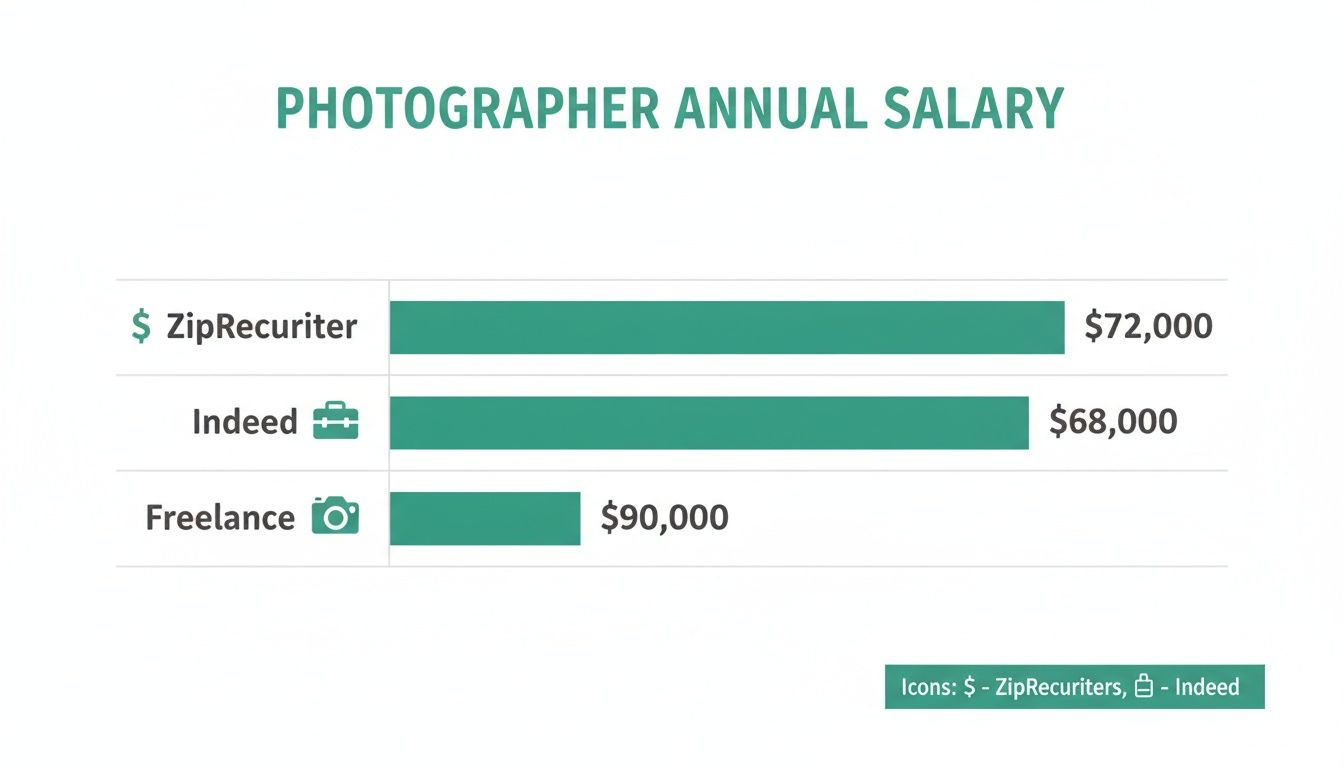
Let’s look at what the big data platforms are saying. Across the United States, the average annual salary for a real estate photographer falls somewhere between $62,338 and $87,293. Breaking it down, ZipRecruiter puts the average right at $62,338 per year, which works out to about $29.97 an hour.
On the other hand, Indeed reports a healthier average base salary of $87,293 per year. And then there’s Comparably, which suggests freelance real estate photographers are averaging a cool $105,408.
Comparing Salary Data Sources
These numbers tell a story. There’s a clear fork in the road here: working a salaried job versus running your own freelance business. A steady paycheck from a company offers security, which is great. But going freelance? That’s where you’ll find the highest income potential.
When you're the boss, your ability to network, build a solid client list, and offer in-demand services directly dictates your earnings.
The biggest takeaway here is that as a freelance photographer, you're in the driver's seat. Your business savvy, paired with your creative talent, is what determines your income—and it can often blow past what you'd make in a salaried role.
To give you a clearer picture, I've put the data from a few sources into a quick-glance table.
Real Estate Photographer Salary Averages At a Glance
Here’s a simple breakdown of the average annual salaries reported by different platforms. Notice the significant jump in earning potential for freelancers.
| Data Source | Average Annual Salary (Salaried) | Average Annual Salary (Freelance) |
|---|---|---|
| ZipRecruiter | $62,338 | N/A |
| Indeed | $87,293 | N/A |
| Comparably | N/A | $105,408 |
This table makes it pretty clear: building your own brand as a freelancer unlocks the highest earning possibilities in this profession.
This next chart paints an even clearer picture, visualizing the difference and showing just how much more you can make when you're working for yourself.
Ultimately, these numbers are just a starting point. Think of them as a baseline. Your actual income will be shaped by the market you work in, the services you sell, and the smart decisions you make along the way. Now, let's get into the factors that will help you build on this foundation and create a truly profitable career.
Building Your Income One Photoshoot at a Time
Those big annual salary numbers are great for a headline, but they don't tell the real story of how you get paid. As a freelance real estate photographer, your income isn't some fixed, predictable salary. It’s built one project at a time, pieced together from a menu of services that all have their own price tag.
Think of yourself less like a photographer and more like a visual marketing partner for agents. You’re not just selling photos; you’re providing the essential tools they need to sell a home faster and for more money. The key to a thriving business is knowing exactly what each of those tools is worth.
Let's break down the most common services and what you can realistically charge. This is your practical playbook for setting rates, whether you're creating your first price sheet or just want to see how your current packages stack up.
H3: Standard Photos: The Foundation of Every Listing
The bread and butter of any real estate photographer's business is the standard photo package. This is your core offering, typically a set of 15-25 high-quality, MLS-ready images for a typical home (say, 1,500-3,000 square feet). These aren't just quick snapshots; they're professionally shot, composed, and edited to make the home look its absolute best.
For this foundational service, you can expect to charge anywhere from $150 to over $300. Your experience and local market will dictate where you land on that spectrum. A new photographer might start closer to $150 to build a portfolio, while a seasoned pro in a hot market like Los Angeles could easily get $318 or more for a basic shoot.
Remember, that fee isn't just for pushing a button on a camera. It covers your travel time, editing hours, gear maintenance, and the expertise needed to create images that make potential buyers stop scrolling.
H3: Premium Add-Ons: Where the Real Money Is Made
Once you've nailed the standard photoshoot, you can seriously boost your income by offering premium add-ons. These are the high-value services that solve specific marketing problems for agents and, as a result, command much higher prices.
To give you a better idea of what to offer, here's a look at some common services and what they typically go for in the U.S. market.
Typical Pricing for Real Estate Photography Services
| Service Type | Typical Price Range (Per Property) | Key Value Proposition |
|---|---|---|
| Standard HDR Photos | $150 – $300+ | The essential marketing asset for every listing. |
| Drone & Aerial Photos | $100 – $250 (as an add-on) | Shows off the entire property, lot size, and location context. |
| Twilight/Dusk Photos | $125 – $275 (as an add-on) | Creates a dramatic, high-end "wow" factor for luxury listings. |
| Cinematic Video Tour | $200 – $800+ | Brings the property to life and creates an emotional connection. |
| Matterport 3D Tour | $200 – $400+ (by sq. ft.) | The ultimate immersive experience; lets buyers "walk through" online. |
| Virtual Staging | $30 – $75 (per photo) | Helps buyers visualize an empty space as a furnished home. |
| 2D Floor Plans | $50 – $100 | Provides crucial layout information buyers want. |
As you can see, these services require more specialized gear, software, and skill—and that’s exactly why they’re so valuable. They give agents a richer, more engaging listing that attracts serious, qualified buyers.
For a much deeper dive into structuring your prices, our guide on how to price real estate photography offers detailed strategies and examples.
H3: Building Smart and Profitable Packages
The most successful photographers rarely sell their services one by one. Instead, they bundle them into smart packages that make it easy for agents to say "yes" while also increasing the average value of each job.
Consider creating a few tiered options that build on one another. Something like this:
- The Essential: 25 HDR Photos. Your basic, get-it-listed package.
- The Pro: 25 HDR Photos + Drone Stills + 2D Floor Plan. This adds powerful context for a modest price jump.
- The Ultimate: Everything in the Pro package + a Cinematic Video + a Matterport 3D Tour. This is your all-in-one marketing powerhouse for high-end properties.
Packaging your services this way guides clients toward higher-value choices and cements your status as a comprehensive marketing partner, not just another "picture-taker." This is how you move from charging for your time to getting paid for the immense value you create.
How Your Location Shapes Your Paycheck
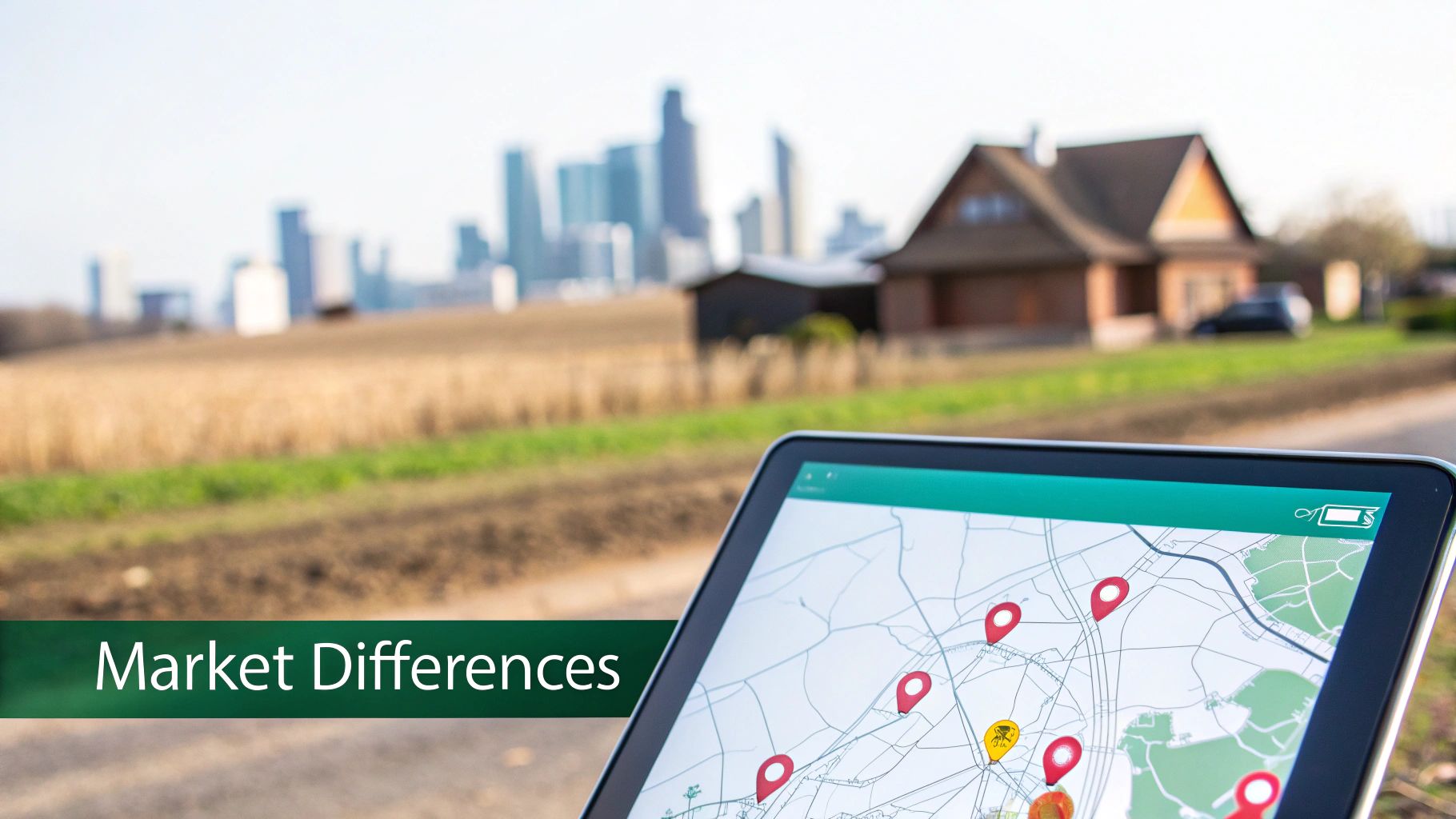
When it comes to your income as a real estate photographer, geography isn't just a detail—it's a deal-maker. Your earnings potential can swing dramatically from one zip code to the next, mirroring the very property values you’re hired to capture.
Think about two photographers with the exact same skills and gear. One is working in a quiet, rural town where the housing market moves at a crawl. The other is hustling in a booming city where homes are sold in a matter of days. The city photographer will almost always earn more. It’s not about talent; it’s about the market they serve.
This all boils down to simple economics. In areas with high property values, fierce competition among agents, and a rapid sales pace, the demand for top-notch marketing—especially professional photography—skyrockets.
Why Location Matters So Much
Here’s a practical way to look at it: an agent listing a $1.2 million waterfront home has a much bigger marketing budget and a heftier commission on the line than an agent selling a $250,000 starter home. That first agent is not only able but also highly motivated to invest in premium photography to attract the right buyers and justify that seven-figure price tag.
Several forces come together to create these high-paying markets:
- High Property Values: Bigger price tags mean bigger agent commissions, which translates into a larger budget for professional photos, videos, and 3D tours.
- Fierce Agent Competition: In a crowded market, real estate agents need an edge. Stunning visuals become a crucial tool to win new listings and impress sellers.
- Fast-Paced Markets: When houses sell fast, agents need a photographer who is both reliable and quick. They're willing to pay a premium for high-quality images delivered on a tight deadline.
These factors create the perfect environment for a photographer to charge higher rates and land more consistent work. If you're in a hot market, you can build a profitable business far more quickly than someone in a slower, less competitive area.
Highest Paying Cities for Photographers
So, where are these goldmines? It's no surprise they're often in major coastal cities and booming Sun Belt metros—places where real estate is a high-stakes game.
The data speaks for itself. Some U.S. markets offer exceptionally high average salaries. Tampa, FL, for instance, leads the pack with an average salary of $163,925 per year. Following close behind are other thriving cities like Austin, TX, at $99,670, Atlanta, GA, at $93,283, and Denver, CO, at $87,227.
What's even more telling is that freelancers in San Jose, CA, report an average total compensation of $208,023—a staggering 97% above the U.S. average. This clearly shows how real estate hotspots directly inflate what a photographer can earn. You can dig deeper into the numbers and learn about the top-paying locations on Indeed.
These figures prove a critical point: your earning potential is directly tied to the economic health and competitiveness of your local real estate market. Choosing the right place to work can be as important as mastering your camera.
Analyzing Your Own Local Market
You don't have to pack your bags for Tampa or San Jose to be successful. The real key is to understand the dynamics of your own backyard. Start by doing a little homework on these local indicators:
- Median Home Prices: Are they on the rise? Climbing prices are a great sign of a healthy market that can support professional photography services.
- Days on Market (DOM): Look for areas with a low DOM. This signals a fast-moving market where agents are desperate for photographers who can provide a quick turnaround.
- Top-Producing Agents: Identify the heavy hitters in your area—the top agents and brokerages. Check out their current listings. Are they already using professional photos? If not, you’ve found a huge opportunity. If they are, you’ve confirmed a market exists.
By getting a handle on these local trends, you can price your services with confidence, knowing exactly what your market can bear. This strategic approach turns your location from a potential limitation into your greatest asset for growth.
Factors That Drive Your Earnings Higher
While your local market definitely sets the baseline, it's your skills and business savvy that truly determine your income ceiling. It's not uncommon for two photographers working in the same city to have drastically different earnings. So, what separates the pros pulling in top dollar from everyone else?
It usually boils down to a handful of key factors. Nailing these is how you move from being just another photographer to becoming an indispensable partner for your real estate clients—the kind they'll happily pay a premium for.
Experience Level and Portfolio Quality
Your experience is your most valuable asset, and your portfolio is the proof. A photographer just starting out might charge $110-$170 for a standard shoot. They're focused on building a client list and getting their reps in. On the flip side, a seasoned pro with a portfolio that speaks for itself can easily command $230-$300 or more for the very same job.
What justifies that jump in price? An experienced photographer isn't just taking pictures; they're crafting a visual narrative. They understand architectural lines, how to manipulate light, and what compositions make a property look its best. Their portfolio showcases this consistency, giving agents peace of mind that every shoot will deliver magazine-quality results.
Think of your portfolio as your best salesperson. It’s a visual resume that instantly communicates your value and lets you skip the price haggling, attracting clients who are searching for quality, not just a bargain.
Turnaround Time Is a Critical Asset
In real estate, time is quite literally money. Agents work on incredibly tight deadlines and often need to get a property listed just a day or two after the photos are taken. If you can deliver beautiful, edited images within 24 hours, you're not just a photographer; you're a problem-solver.
This isn't just a nice little perk—it's a core part of the service that many agents will gladly pay extra for. When you can consistently deliver stunning photos faster than the competition, your value skyrockets.
Consider making a guaranteed 24-hour turnaround a standard feature of your packages. You could even offer a "rush" option for an extra fee. This positions you as a reliable pro who gets the urgency of the market.
Mastering the Art of the Upsell
The highest-earning photographers rarely stop at a basic photo package. They’ve become masters of the upsell, strategically offering add-on services that agents genuinely need. This provides massive value to the client while significantly boosting the total revenue from each shoot.
A basic photo package gets the listing online, sure, but the add-ons are what make it truly stand out.
- Drone Photography: This gives buyers the bigger picture, showing off the property's layout, lot size, and proximity to parks or schools. It helps an agent justify a higher asking price.
- Twilight Shoots: Nothing says "luxury" like a dramatic twilight shot. These images grab attention online and are perfect for high-end listings.
- Virtual Staging: This is an absolute game-changer for vacant homes. For a relatively small fee (often $30-$75 per photo), you can digitally furnish an empty space, helping buyers imagine themselves living there.
By bundling these services into tiered packages, you make it easy for clients to see the value in upgrading, which means more revenue per job without having to find more clients.
Understanding Image Licensing and Usage Rights
This is one of the most overlooked but crucial factors impacting your bottom line. When an agent hires you, they aren't buying the photos outright. They are purchasing a license to use those photos for a very specific purpose: marketing that one property while it's for sale.
You still own the copyright to your images. This is a critical distinction that protects your work and opens up other potential revenue streams.
Your contract should spell out the licensing terms in plain English, including:
- Who can use the images (the specific agent and their brokerage).
- How they can be used (on the MLS, social media, property flyers).
- For how long the license is valid (typically for the duration of the listing).
If an architect, builder, or stager who worked on the home wants to use your photos for their own portfolio, they need to purchase a separate license from you. This creates an opportunity to earn more from a single shoot. Clearly explaining this to your clients not only establishes your professionalism but also creates new ways to monetize your work.
Choosing Your Path: Freelance vs. Salaried
One of the biggest decisions you'll make in your photography career is how you want to work. It’s a choice that will fundamentally shape your day-to-day life and, more importantly, how much you can earn. Are you looking for the steady paycheck of a salaried gig at an agency, or do you want to strike out on your own as a freelancer and build something from the ground up?
Let's break down what each path really looks like.
A salaried job is all about predictability. You get a steady paycheck, benefits, and you never have to wonder where your next shoot is coming from because the company handles all the client-finding and marketing. That security is great, but it usually comes at a cost: your income has a ceiling. Your pay is determined by the company, not by how hard you hustle or the unique value you bring to a specific project.
The freelance route? That's a whole different ballgame. It offers uncapped earning potential, but it asks for a lot more than just a good eye for photography.
The Freelance Advantage: No Glass Ceiling
When you’re a freelancer, you're the boss. Simple as that. You're in the driver's seat for everything—your pricing, your brand, your services, and your schedule. Every dollar you make (after expenses, of course) goes right into your pocket. This complete control is exactly why freelancers so often out-earn their salaried peers.
The numbers don't lie. Independent real estate photographers pull in an average of $105,408 a year, with the potential to earn anywhere from $46,437 to a staggering $478,317. You can review the full freelance salary analysis on Comparably to see the data for yourself. That huge range tells a story: your income is a direct reflection of your entrepreneurial spirit.
Of course, this means you have to wear multiple hats. You're not just the photographer; you're the marketing department, the sales team, and the bookkeeper all rolled into one. For a deeper dive into everything this entails, check out our guide on how to become a real estate photographer.
Understanding the Trade-Offs
Going freelance is a classic trade-off between security and opportunity. The potential for a higher income is very real, but so are the responsibilities. You’re on the hook for drumming up new business, managing your own finances, and covering costs like insurance and gear.
The core difference is this: a salaried job pays you for your time and skills within a set structure. A freelance business pays you for the value you create, with no upper limit.
Here’s a quick side-by-side to help you weigh your options:
Freelance Photographer
- Pros: Uncapped earning potential, total control over your schedule and brand, and you keep 100% of the profits.
- Cons: Inconsistent income (especially at first), you’re responsible for all business operations (marketing, taxes, insurance), and no employer-provided benefits.
Salaried Photographer
- Pros: Stable and predictable income, benefits like health insurance and paid vacation, and no need to chase down clients.
- Cons: A firm cap on what you can earn, less creative freedom, and you’re working within someone else’s rules and pricing.
Why Top Agents Pay for Top Freelancers
So, why are real estate agents willing to pay a premium for a skilled freelancer? Because it makes them money. A lot of money.
High-quality, professional photos aren't just a "nice-to-have"—they are a powerful sales tool. The data is crystal clear: listings with professional photos sell 32% faster. On top of that, they can sell for $934 to $116,076 more. When an agent sees numbers like that, hiring a great photographer stops being an expense and becomes an investment with a massive ROI.
They aren't just buying pictures; they're buying a faster sale and a bigger commission check. And here's the kicker: despite the obvious benefits, only about 35% of agents currently use professional photographers. That signals a huge, underserved market with plenty of room for talented freelancers to build a thriving business.
Actionable Strategies to Grow Your Photography Income
Knowing what you could be making is one thing, but actually putting more money in your pocket is another challenge entirely. Understanding the average income ranges is a great start, but climbing into those higher brackets requires a smart, repeatable strategy. It's time to move from theory to practice.
This isn't about running yourself ragged shooting more and more properties; it's about working smarter. The real secret is building a business that not only produces incredible images but also delivers a client experience that agents can't stop talking about. By focusing on a few core areas, you can create a reliable growth engine that pulls in new projects and turns one-time gigs into loyal, long-term partnerships.
Build a Portfolio That Sells for You
Think of your portfolio as your best salesperson—it works 24/7. It needs to do more than just show off pretty pictures; it has to scream professionalism, reliability, and the kind of high-quality results an agent can count on every single time. It's your visual handshake, proving you can help them sell listings faster and for top dollar.
Be ruthless when curating your portfolio. It should show off your versatility, featuring everything from a cozy downtown condo to a sprawling luxury estate. Make sure to sprinkle in examples of your high-value add-ons like dramatic twilight shots or breathtaking drone photos. This instantly shows agents you can handle any property they throw at you and justifies your premium pricing from the get-go.
Master the Art of Networking
In real estate, it’s all about who you know. You can't just sit back and hope the phone rings—you have to get out there and build real connections in your local market. Becoming the go-to photographer means making it impossible for agents to forget you.
Your goal is simple: when an agent thinks "I need photos for this new listing," your name should be the first one that comes to mind. This is achieved through consistent, professional outreach.
Here are a few practical ways to make that happen:
- Identify Top Agents: Do your homework and find out who the top-producing agents and brokerages are in your city. These are the pros who already understand the value of great marketing and have the budget to pay for it.
- Offer Value First: Ditch the hard sell. Instead, lead with value. Offer a complimentary headshot session to an agent you want to work with, or provide a free drone photo for one of their current listings to give them a taste of your work.
- Attend Industry Events: Show up where the agents are. Go to local real estate meetups, brokerage events, or even open houses. Introduce yourself, exchange business cards, and focus on building genuine relationships.
For a complete playbook, check out our guide on how to get new clients for even more detailed strategies on effective outreach.
Create Irresistible Service Packages
Stop selling individual services and start selling complete solutions. The most successful photographers bundle their offerings into tiered packages that make the agent's decision a no-brainer. This approach not only simplifies the sales process but also naturally guides clients toward higher-value options, boosting your average revenue per job.
Structure your packages logically so each tier is a clear step up. For instance, a basic package might cover just the essential photos. The mid-tier option could add in drone photography and a floor plan. Your premium package could be the "all-in" solution, bundling everything from photos and drone to a cinematic video tour and a Matterport 3D scan—the ultimate marketing toolkit for a standout listing.
Frequently Asked Questions About Photographer Salaries
Let's wrap up by tackling some of the questions I hear all the time from photographers trying to figure out their earning potential. Think of this as a quick-reference guide to help you move forward with a bit more clarity.
What Is a Realistic Starting Salary?
When you're just starting out as a freelance real estate photographer, a realistic target for your first couple of years is somewhere between $45,000 and $60,000. That number can swing quite a bit depending on your local market, how quickly you can get your name out there, and what services you're ready to offer from day one.
The trick in the beginning is to pour your energy into building a killer portfolio and connecting with local agents. Once you've got a steady stream of work, your reputation will grow, and your income will follow right along with it.
How Many Shoots Do I Need Per Week?
This really comes down to your pricing and what your local market can bear. Let's do some simple math: if your average invoice is $350, landing just three jobs a week gets you over $54,000 for the year.
The photographers pulling in the big numbers are often doing 5-10 shoots a week. But they aren't just running from one basic photo job to the next; they're mixing in high-value services like video tours and Matterport scans. It’s not just about volume. It’s about getting the most out of every single appointment.
Your income isn't just about how many homes you shoot; it's about the value you provide at each one. Upselling a drone package or a virtual tour can double your revenue without adding another client to your schedule.
Can I Really Make Six Figures?
Yes, absolutely. Hitting that six-figure milestone is a very real goal for photographers who treat this like a business, not just a creative gig. It usually boils down to a few key things:
- Working in a healthy real estate market where home prices are solid.
- Offering the whole package—photos, video, drone, and 3D tours.
- Building a recognizable brand that earns you a list of loyal, repeat clients.
- Running a tight ship by managing your time and costs effectively.
Getting to that level means you've made the leap from being just a photographer to being a smart business owner.
Ready to connect with high-quality agents and take control of your bookings? Join PropPhoto today to build your professional profile, showcase your portfolio, and start getting noticed by clients in your area. Create your free profile and grow your business with PropPhoto.
Article created using Outrank

